
Sniffer 4D Mini
Pocket-Sized Gas Detector - Sniffer Mini
The Sniffer 4D Mini is a system for multi-gas detection and mapping that can be used with the DJI M30/M30T.
It can detect up to 9 gases simultaneously and measures and visualizes gas concentration distributions in 3D and real-time.
Its real-time visualization and analytical software provide important information for decision making.
The Sniffer 4D Mini integrates with DJI M300 RTK for real-time data display and control via DJI Pilot and Cloud.
It can be used in various application scenarios such as hyper-local environmental monitoring, hazmat response, leak detection, and ship issuance and FSC monitoring.
The Sniffer 4D Mini is designed with hardware and advanced algorithms to ensure data integrity and reliability with a short response time.
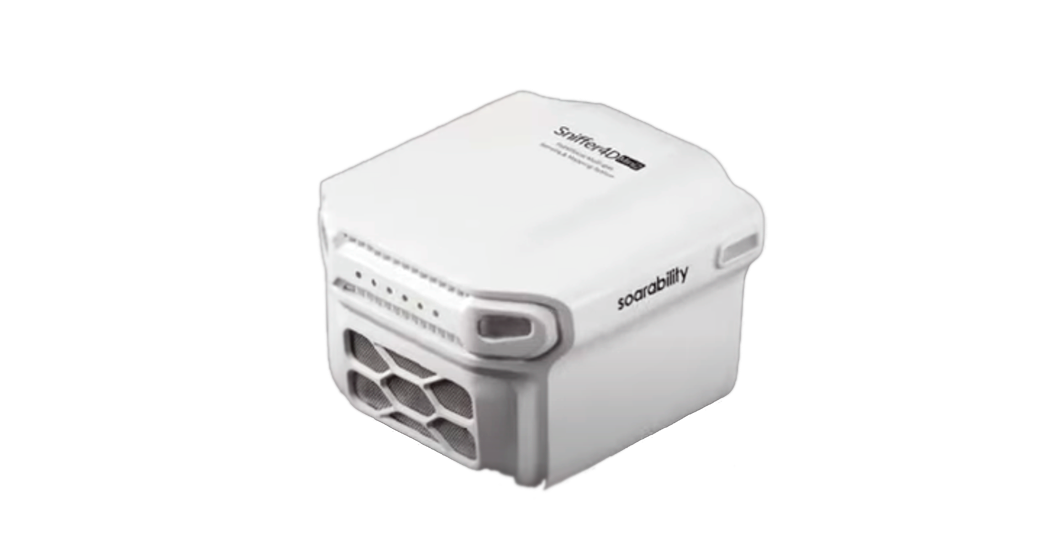

Sniffer Mini
The Sniffer 4D Mini is a powerful system designed for multi-gas detection and mapping. This innovative technology is compatible with the DJI M30/M30T and can detect up to 9 gases simultaneously. By measuring and visualizing gas concentration distributions in real-time and 3D, it provides users with critical data to make informed decisions.
Real-time Visualization and Analytical Software
One of the most remarkable features of the Sniffer 4D Mini is its real-time visualization and analytical software. This software provides users with important information that can aid in decision-making. With cellular connectivity, the system allows the transmission of information in real-time with an unlimited range to different locations.
Integration with DJI M300 RTK
The Sniffer 4D Mini can integrate with DJI M300 RTK for real-time data display and control via DJI Pilot and Cloud. This integration offers unprecedented information viewing, ideal for the M30 remote control monitor.
Application Scenarios
The Sniffer 4D Mini is a versatile system that can be utilized in various application scenarios. It is perfect for hyper-local environmental monitoring, hazmat response, leak detection, and ship issuance and FSC monitoring. The system can quickly scan an area and get the hyper-local distribution of contamination in 3D. The results can be used to pinpoint exact locations of leak emission sources to understand how contamination is transported.
Advanced Hardware and Algorithms
The Sniffer 4D Mini is equipped with advanced hardware and algorithms that ensure the reliability and integrity of data with a short response time. The module mounts quickly to the drone, and the cable connection is made in seconds. The 6 status LEDs allow users to quickly understand the process they are in, increasing their efficiency.
In conclusion, the Sniffer 4D Mini is a powerful system designed for multi-gas detection and mapping. With real-time visualization and analytical software, the system provides users with critical data to make informed decisions. The system can integrate with DJI M300 RTK, and its application scenarios include hyper-local environmental monitoring, hazmat response, leak detection, and ship issuance and FSC monitoring. The Sniffer 4D Mini is equipped with advanced hardware and algorithms that ensure the reliability and integrity of data with a short response time.
Comparison table of the three major methane detection technologies used in field inspections:
Feature / Metric
OGI (Optical Gas Imaging)
TDLAS (Laser Absorption)
Gas Sniffers (PID, FID, etc.)
Detection
Infrared plume image
Methane-specific laser absorption
Chemical/electrical gas sensing
Output
Visual
Quantitative (ppm / ppm-m)
Quantitative (ppm)
Sensitivity
Moderate (<100 ppm)
High (ppb–ppm)
High (varies by sensor)
Methane Selectivity
Moderate (others detected too)
High (methane-tuned)
Variable
Quantification
No
Yes (with path length)
Yes
Range / Coverage
Moderate to wide
Long (10–250 m)
Point only
Real-Time
Yes
Yes
Yes
Conditions
Needs thermal contrast
Stable in most environments
Affected by weather
Automation
High (UAVs, robots)
High (UAVs, fixed units)
Low–Medium (handheld)
Remote Use
Excellent (standoff)
Excellent (remote possible)
Poor (manual, close-up)
Speed
Fast (area scan)
Fast (drones, long path)
Slow (point by point)
Cost
High ($80K–150K)
Medium ($10K–60K)
Low–Medium ($2K–20K)
Best Use
Visual leaks, LDAR, complex sites
Quantifying, monitoring, drones
Localized, indoor leaks
Regulatory Use
Accepted (OGI/Method 21 alt.)
Gaining approval for quantification
Standard Method 21
Our Blog


Drones Plus Robotics deliver innovative commercial and specialized applications, offering businesses advanced solutions for efficiency, safety, and growth.

Cutting edge drones and robotic systems enable precise environmental and agricultural monitoring, improving sustainability, crop health, and resource management.

Robotics and drone technology revolutionize industrial and infrastructure inspection, ensuring accurate data collection, reduced downtime, and enhanced safety.

Drones and robotics strengthen public safety and security by providing real-time surveillance, rapid response, and advanced threat detection.


Social
Contact
Drones Plus Robotics
8549 Gaylord Pkwy #105
Frisco
TX 75034
10am - 6pm Mon - Fri
Tel: (469) 757-4497
.png)